
Charging an electric car from your own roof is the cheapest way to fuel a vehicle — and in a region with unstable grids, it’s also a way to keep driving when the network fails.
But “EV + solar” isn’t as simple as plugging in. The car is a big, hungry load that can dwarf everything else in your home. This guide shows how to size it, connect it, and get the economics right.
Why Charge an EV From Solar?
- Fuel cost collapse: home solar charging can cost a fraction of public rapid charging — or of petrol.
- Grid independence: in Ukraine, solar + battery lets you charge even during blackouts.
- Self-consumption beats export: in Poland’s net-billing model, using your own surplus to charge the car is worth more than selling it. Context: subsidies & net-billing.
- Lower carbon: solar-driven kilometres are among the cleanest possible.
The Core Problem: EV Loads Are Big
A single EV charge session can consume more energy than your house uses in a day.
| EV battery | Usable capacity | Energy to charge 0→80% |
|---|---|---|
| Small city EV | 40 kWh | ~32 kWh |
| Mid-size EV | 60 kWh | ~48 kWh |
| Long-range EV | 90 kWh | ~72 kWh |
Compare that to a home’s ~7 kWh daily need (see the sizing guide). One EV fill can equal a week of household electricity. Your system must be sized for this.
Three Ways to Charge From Solar
1. Direct solar (daytime, no battery)
Charge while the sun shines and the car is parked. Simple and efficient — but only works when you’re home during the day and the sun is up.
2. Solar + home battery
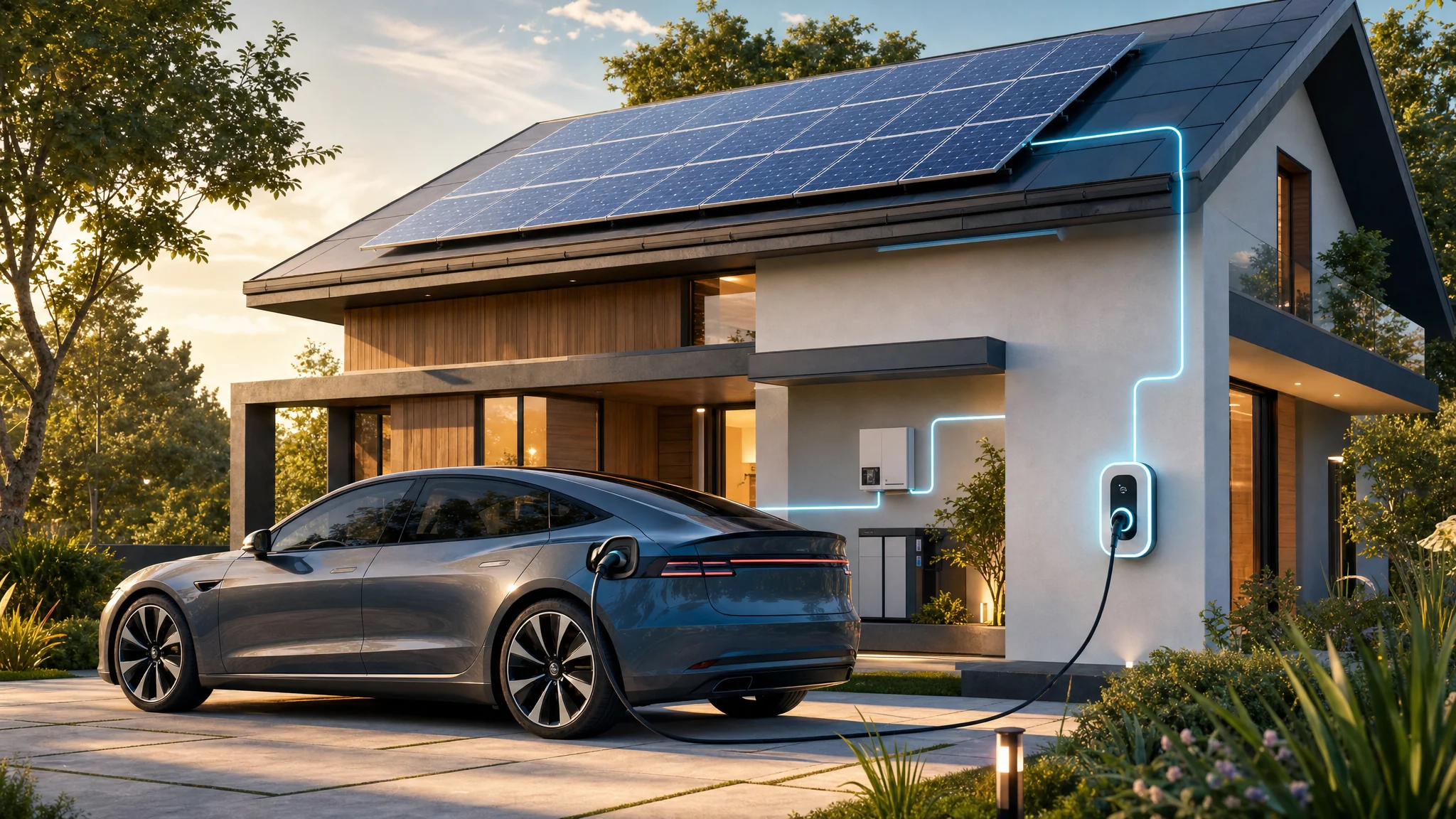
Excess solar charges your home battery; the battery then charges the car. Decouples charging from sunshine, and works during outages. This is the hybrid ESS model.
3. Grid + solar (net-billing / off-peak)
Charge from the grid at off-peak rates, offset by solar exports. Simplest if you don’t need outage protection.
Charger Types Explained
| Type | Power | Notes |
|---|---|---|
| Level 1 (Schuko) | 2.3 kW | Slow — 15–30 h for a full charge |
| Level 2 (AC wallbox) | 7–22 kW | Standard home charger; ~6–10 h |
| DC fast charging | 50–350 kW | Public only; not a home option |
For home solar, a Level 2 wallbox (7–11 kW) is the sweet spot — fast enough to be practical, manageable within a home’s power budget.
Sizing Solar for an EV
Rule of thumb: 1 kW of solar ≈ 2.5–3.5 kWh/day in Ukraine/Poland.
| EV km/year | Annual energy | Solar needed (approx.) |
|---|---|---|
| 10,000 km | ~1,800 kWh | 1.5–2 kW extra |
| 15,000 km | ~2,700 kWh | 2.5–3 kW extra |
| 20,000 km | ~3,600 kWh | 3.5–4 kW extra |
Example: adding 3 kW of panels on top of a home system covers roughly 15,000 km/year of driving from the sun.
Then size the inverter and battery for the charging power. A 7 kW wallbox means the inverter (or grid import) must supply 7 kW on top of house loads — check total capacity.
The Battery Question: Should You Add Storage?
Storage lets you charge the EV from stored solar and keep charging during blackouts — a big deal in Ukraine.
| Approach | Pros | Cons |
|---|---|---|
| No battery (daytime solar only) | Cheapest | No charging at night/outages |
| With home battery | Flexible, outage-proof | Higher cost |
| EV battery as home storage (V2H/V2G) | Doubles battery value | Needs compatible car + charger |
V2H (Vehicle-to-Home) is emerging: your car battery powers the house. It’s promising but still limited by vehicle and charger compatibility — worth watching, not yet a plug-and-play default.
Economics: Solar-Charged vs Alternatives (per 100 km)
| Method | Approx. cost / 100 km |
|---|---|
| Petrol car (~7 L/100 km) | €10–€13 |
| Public DC fast charging | €7–€12 |
| Home grid charging (off-peak) | €3–€6 |
| Home solar charging | €1–€3 |
Solar charging can cut fuelling cost by 80–90% versus petrol. Over 15,000 km/year, that’s thousands saved annually — often enough to justify the extra panels on its own.
Practical Setup Checklist
- [ ] Decide charging pattern (daytime solar vs battery vs overnight)
- [ ] Install a Level 2 wallbox (7–11 kW), ideally with solar-aware scheduling
- [ ] Add solar capacity for annual driving needs
- [ ] Ensure inverter/grid can supply wallbox + house loads together
- [ ] Consider a home battery if you need outage charging
- [ ] Use a charger that can follow solar surplus (charge only when producing)
- [ ] Check your grid connection allows the extra load
- [ ] Verify EV model’s on-board charger limits (many cap at 7–11 kW AC)
Smart-charging tip: solar-aware wallboxes ramp charge power to match real-time production — maximising self-consumption and minimising grid draw.
Ukraine vs Poland Considerations
| Ukraine 🇺🇦 | Poland 🇵🇱 | |
|---|---|---|
| Grid reliability | Poor — outages disrupt public charging | Good, but improving |
| Priority | Charge during outages (ESS + battery) | Maximise savings vs net-billing |
| Public charging | Uneven | Well-developed |
| Best setup | Solar + home battery + wallbox | Solar + wallbox + off-peak grid |
| EV adoption | Growing | Growing fast |
In Ukraine, the standout advantage is charging your car when the grid is down — a capability a generator or public charger can’t reliably provide. See why an ESS beats a generator in solar vs diesel.
Common Mistakes
- Sizing solar only for the house, ignoring the EV’s annual energy.
- Buying a wallbox bigger than the car can accept (many EVs cap at 11 kW AC).
- No battery, then wondering why night charging pulls from the grid.
- Forgetting total load. Inverter + wallbox + house can exceed capacity.
- Ignoring grid connection limits — an upgrade may be required.
The Bottom Line
Charging an EV from solar is the cheapest way to run a car and, with a home battery, a way to keep driving through blackouts. The keys are to size solar for annual driving, install a solar-aware Level 2 wallbox, and decide whether you need storage for outage charging.
Get those three right and your car, your home, and your roof become one integrated energy system.
Read next: What is an ESS? · Solar subsidies & net-billing · How to size your backup