
Every autumn the same worry arrives: “Will my solar system survive the winter?” For anyone relying on solar for backup power in Ukraine or heating support in Poland, it’s not a trivial question.
Here’s the good news: cold is your friend, and snow is manageable. The real winter challenge is daylight hours, not temperature. This guide explains what actually happens to solar output from November to February — and how to keep your system productive.
Do Solar Panels Work in Cold Weather?
Yes — often better than in summer.
Solar panels are rated to produce their nominal output at 25 °C cell temperature. Counter-intuitively, that means:
- Cold, clear winter day: panels can produce more voltage and thus slightly higher instantaneous power than the same panel on a hot summer day.
- Hot summer day: cell temperatures hit 50–65 °C, and output drops 10–20% below nameplate.
So temperature isn’t the problem. Low sun angle and short days are.
The Real Winter Factors
| Factor | Effect on output |
|---|---|
| Shorter days (8–9 h in Dec) | Biggest loss — less time to produce |
| Lower sun angle | Less irradiance per m² |
| Persistent cloud cover | 30–60% output reduction in grey weather |
| Snow cover | Up to 100% loss while covered |
| Snow reflection (albedo) | Bonus for bifacial panels |
| Cold temperatures | Slight efficiency gain |
Net: expect winter output in Ukraine/Poland to drop to roughly 15–30% of summer on average — mostly due to daylight, not snow.
How Much Snow Is a Problem?
It depends on the panel’s angle and the snow type:
| Situation | Impact |
|---|---|
| Light dusting | Little effect — light passes through or melts fast |
| Wet, heavy snow | Full blockage until cleared |
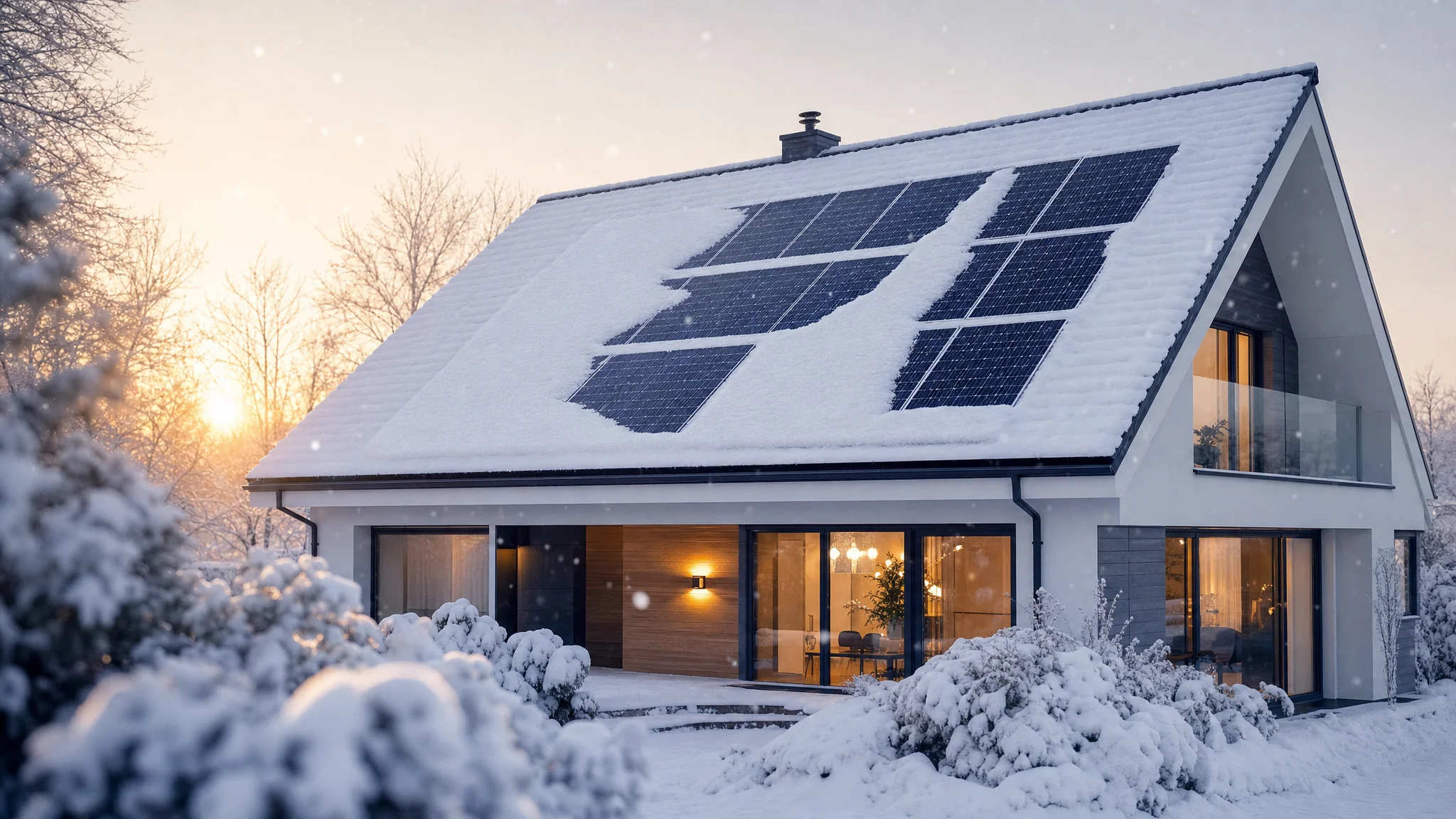
| Steep tilt (> 40°) | Snow slides off on its own |
| Near-flat roof (< 15°) | Snow accumulates — manual clearing needed |
Key insight: dark panels warm slightly in sun and, on a tilted mount, snow often slides off by itself. A steep winter tilt also improves low-angle sun capture — a double win.
Should You Clear Snow Off Panels?
Sometimes — but carefully.
Do clear if:
- Snow has sat for days and you need the power (especially for backup).
- The roof is safely accessible (ground-mounted or low, safe pitch).
- You have a proper long-handled soft snow rake.
Don’t clear if:
- The roof is steep, icy, or high — falling off is far worse than losing a day of charge.
- You’d risk scratching the glass with a hard tool.
- More snow is forecast anyway.
Never use metal shovels, hammers, or hot water — they crack glass and void warranties.
Maximising Winter Production
1. Optimise tilt for winter sun
A steeper tilt captures low-angle winter sun better and sheds snow. Many installers set a compromise angle; if your roof is adjustable or ground-mounted, tilting steeper for winter helps.
2. Keep panels clean and clear
Dust, leaves, and bird droppings cost more in winter when every photon counts. Our general panel care overlaps with panel type considerations — dark, high-efficiency panels absorb the most in weak light.
3. Add more panels than summer needs
Since winter output is low, sizing the array for winter, not summer, means headroom in the sunnier months. This matters most if you rely on solar for backup.
4. Pair with a big enough battery
Short winter days mean less charging and higher consumption (lighting, heating). A larger battery bank smooths this — see how to size your backup.
5. Consider bifacial panels
On a bright snowy ground, bifacial panels capture reflected light from below — snow becomes a bonus rather than just an obstacle.
6. Integrate with heating
In winter, your biggest load is heating. A heat pump + solar combination lets solar carry much of that load across the year.
Winter and Backup Power: The Honest Picture
If you’re in Ukraine relying on solar for blackout backup, be realistic:
- Winter solar alone won’t carry you. Days are short and often grey.
- Your system will lean on the battery + grid more, with solar topping up.
- Size the battery for worst-case autonomy, not average.
- Keep a grid or generator fallback for multi-day grey spells.
Solar still reduces how much you draw from the grid and extends battery runtime on any sunny winter day — it just isn’t a standalone winter power source at these latitudes.
Maintenance Checklist Before Winter
- [ ] Clean panels of summer dust and debris
- [ ] Inspect mounting for loose bolts before snow load
- [ ] Check cable insulation for cracks (cold makes brittle)
- [ ] Verify drainage — no water pooling that can freeze
- [ ] Confirm inverter/battery are in a frost-free location
- [ ] Test the backup switchover before the outage season
- [ ] Review battery reserve settings for winter
Common Winter Myths
- “Solar doesn’t work in winter.” It does — just less, mostly due to daylight hours.
- “You must clear snow immediately.” Often it slides off; safety first.
- “Cold damages panels.” No — cold is fine. Ice loading is the structural concern.
- “You need extra heating for panels.” No — that’s a waste of energy.
The Bottom Line
Winter doesn’t break solar — it reduces it, mainly through shorter days and cloud. Cold temperatures actually help efficiency, and a steep tilt plus the occasional careful snow clear keeps production ticking.
Design for winter, not for July: size the array generously, give yourself battery headroom, and keep a fallback for the greyest weeks.
Read next: Solar panel types explained · How to size your backup system · Heat pumps + solar