
“How much does solar cost?” is the first question everyone asks — and the one most websites answer with vague ranges.
This guide gives real 2026 numbers for Ukraine and Poland: what panels cost per watt, what a full system runs, where the money actually goes, and how to avoid the two most common ways people overspend.
All figures are in euros (€) with approximate Polish złoty (PLN) and hryvnia (UAH) equivalents where useful.
The Short Answer
| System size | Ukraine (installed) | Poland (installed) |
|---|---|---|
| 3 kW (small home, backup) | €3,000–€4,500 | €3,500–€5,000 |
| 5 kW (typical home) | €4,500–€7,000 | €5,500–€8,000 |
| 10 kW (large home / small business) | €8,000–€13,000 | €10,000–€15,000 |
| 5 kW + 10 kWh battery (full backup) | €7,000–€10,000 | €9,000–€13,000 |
The gap between the two countries comes mostly from labour cost, VAT, and paperwork — equipment prices are nearly identical across the border.
What You’re Actually Paying For
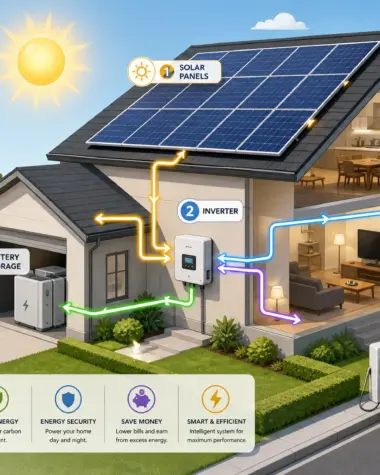
A solar installation is not “just panels.” On a typical 5 kW system, the cost splits roughly like this:
| Component | Share of total |
|---|---|
| Solar panels | 25–35% |
| Hybrid or string inverter | 20–30% |
| Battery (if included) | 25–40% |
| Mounting, cabling, protection | 10–15% |
| Labour & commissioning | 10–20% |
| Design, permits, grid paperwork | 3–8% |
Notice that panels are not the biggest line item — the inverter and battery usually are. That’s why our hybrid inverter buying guide matters as much as panel choice.
Panel Prices Per Watt (2026)
Panel prices have stabilised after years of decline. Expect:
| Panel type | Price per watt | Notes |
|---|---|---|
| Polycrystalline | €0.20–€0.28 | Cheapest; being phased out |
| Monocrystalline (standard) | €0.22–€0.32 | Best value, most common |
| Monocrystalline (high-efficiency) | €0.30–€0.45 | More power per m² |
| Bifacial | €0.28–€0.40 | Gains from reflected light |
So a 450 W monocrystalline panel runs about €100–€145. A 5 kW array needs 11–12 such panels: €1,200–€1,700 for the panels alone.
Not sure which type fits your roof? Our solar panel types guide breaks down the trade-offs.
Inverter Cost (2026)
| Inverter type | 5 kW price | Notes |
|---|---|---|
| String (grid-tied only) | €400–€700 | Cheapest, useless in blackout |
| Hybrid (grid + battery) | €900–€1,800 | The right choice for Ukraine/Poland |
| Off-grid | €700–€1,400 | No grid connection |
| 3-phase hybrid (10 kW) | €1,800–€3,200 | For larger/business systems |
Brand matters: Deye and Growatt sit at the value end, Victron and SMA at the premium end. See how they compare in our Deye vs Growatt vs GSL breakdown.
Battery Cost (2026)
This is where budgets swing hardest.
| Battery | Capacity | Price |
|---|---|---|
| LiFePO4 48 V module | 5 kWh | €1,100–€1,600 |
| LiFePO4 rack battery | 10 kWh | €2,000–€3,000 |
| LiFePO4 wall-mount | 10 kWh | €2,200–€3,300 |
| 15 kWh stack | 15 kWh | €3,000–€4,500 |
Per kWh, quality LiFePO4 now lands around €200–€300/kWh installed. Cheap lead-acid looks cheaper upfront but dies in 3–5 years under daily deep cycling — a false economy our LiFePO4 guide explains in full.
Labour, Mounting & “Soft Costs”
| Item | Ukraine | Poland |
|---|---|---|
| Labour (per 5 kW install) | €300–€700 | €700–€1,400 |
| Mounting system (rails, hooks) | €400–€800 | €500–€900 |
| Cabling + protection (DC/AC, SPD) | €300–€600 | €400–€700 |
| Permit / grid paperwork | €100–€400 | €300–€800 |
| VAT | 20% | 23% (8% on some residential) |
Poland’s costs are higher mainly because of labour rates and formal grid-connection bureaucracy. Ukraine, for now, has faster, cheaper installation — but less subsidy support (see below).
Hidden Costs That Surprise People
- Roof reinforcement — older roofs may need structural work before mounting.
- Long cable runs — if the inverter isn’t near the array, DC cable cost climbs.
- Consumption meter upgrades — some grid operators require a bi-directional meter.
- Scaffolding — multi-storey buildings add €300–€800.
- Battery expansion later — leaving no rack space means re-buying hardware.
- Monitoring gateway — some inverters need an add-on dongle for app data.
Budget a 10–15% contingency on top of any quote.
Ukraine vs Poland: What Changes
| Factor | Ukraine 🇺🇦 | Poland 🇵🇱 |
|---|---|---|
| Grid reliability | Poor (16 h blackouts) | Good, but rising outages |
| Main driver | Backup / survival | Bill savings + subsidies |
| Subsidies | Limited, ad-hoc | Strong (see below) |
| Typical system | Hybrid + big battery | Hybrid + moderate battery |
| Payback driver | Avoiding generator fuel | Lowering bills |
| Labour cost | Lower | Higher |
In Ukraine, solar is bought for resilience — the payback math is measured against diesel generator running costs, which we cover in our solar vs diesel generator comparison.
In Poland, it’s bought for return on investment, boosted by government programmes. Read the full subsidies breakdown before you buy.
How to Get the Best Price
- Get 3 quotes minimum. Prices for identical equipment vary by 20–40%.
- Buy equipment and labour separately if you’re confident — it often saves 10–15%.
- Skip premium brands for the battery if budget is tight; mid-tier LiFePO4 is reliable.
- Stage the build. Inverter + battery now, panels later.
- Size right the first time. Oversizing is the most common waste — use our sizing guide.
- Check subsidy eligibility first — it can cut your net cost by a third.
Real-World Example: 5 kW Hybrid Home System
| Item | Cost |
|---|---|
| 11 × 450 W monocrystalline panels | €1,400 |
| 5 kW hybrid inverter (Deye) | €1,100 |
| 10 kWh LiFePO4 battery (GSL) | €2,500 |
| Mounting + cabling + protection | €900 |
| Labour + commissioning | €800 |
| Contingency (10%) | €670 |
| Total | ≈ €7,370 |
That’s a fully independent backup system that runs a typical home through a 16-hour outage and pays back over time via bill savings.
Frequently Asked Questions
Are prices falling? Panel and battery prices continue their slow decline, but labour and grid costs are rising — net prices are roughly flat.
Is solar worth it in 2026? In Poland, yes — subsidies and high retail rates make payback 5–8 years. In Ukraine, yes — for backup value, not just bills.
Can I install it myself? Legally you can often do the mounting, but grid connection and protection must be signed off by a certified electrician.
The Bottom Line
Expect €1,000–€1,500 per installed kW for a basic grid-tied system, and €1,400–€2,000 per kW for a full hybrid + battery backup system in Ukraine and Poland in 2026.
The single biggest lever on your final price isn’t the panel brand — it’s sizing correctly and claiming the subsidies you’re entitled to. Get those two right and everything else falls into place.
Read next: Solar subsidies in Poland & Ukraine · How to calculate your power needs · Solar vs diesel generator