
If you’re building a solar + battery backup system, the panels are actually the least critical component. The inverter and battery matter more.
But panels matter for one thing: charging your battery during a blackout. And in Ukraine, that means you want the most reliable panels that survive transport, handle debris impact, and produce power even in less-than-ideal conditions.
This guide covers the three main panel types, what’s best for backup systems, and practical advice for war-zone installation.
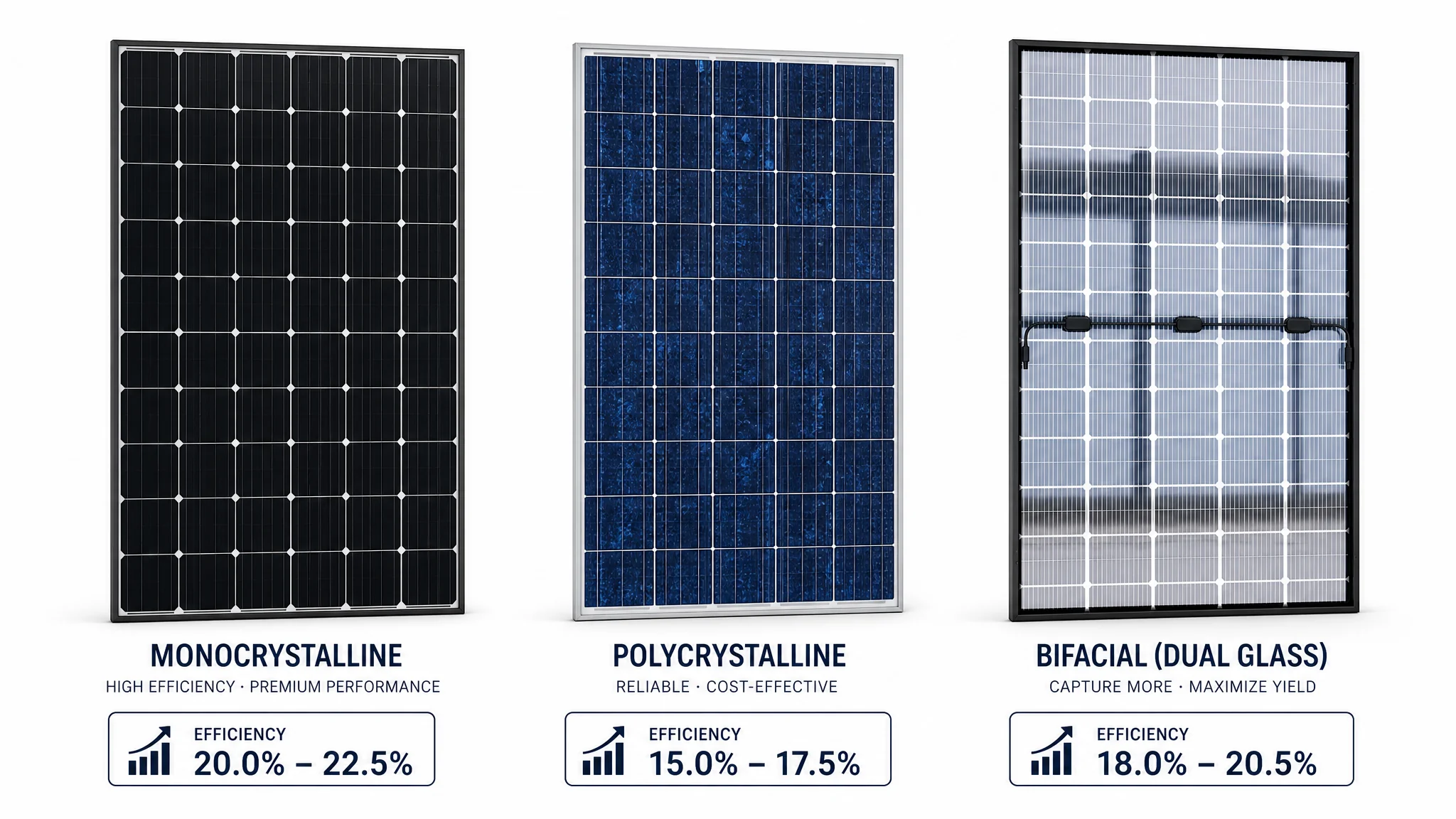
The Three Types (Quick Overview)
| Type | Efficiency | Price | Best For |
|---|---|---|---|
| Monocrystalline TOPCon | 21–23% | $$ | Most homes — best efficiency per m² |
| Polycrystalline | 16–19% | $ | Large roofs/ground — budget pick |
| Bifacial | 21–23% + 5–25% rear gain | $$$ | Ground mounts, snowy regions |
1. Monocrystalline TOPCon — The Standard for 2026
Most panels sold in 2026 are TOPCon monocrystalline — the latest evolution of monocrystalline technology.
| Spec | Value |
|---|---|
| Efficiency | 21–23% |
| Lifespan | 30+ years |
| Degradation | ~0.4%/year |
| Price per watt | €0.20–0.35 |
| Appearance | Black (uniform, sleek) |
Why it’s the standard:
- Best efficiency for limited roof space (urban homes, small businesses)
- Better low-light performance (charges battery earlier in morning, later in afternoon)
- Handles high temperatures better than older types
- 25+ year warranty from Tier-1 brands
Best for: Most installations in Ukraine and Poland. If in doubt, buy TOPCon monocrystalline.
2. Polycrystalline — The Budget Option
Older technology. Lower efficiency, lower price.
| Spec | Value |
|---|---|
| Efficiency | 16–19% |
| Lifespan | 25–30 years |
| Degradation | ~0.6%/year |
| Price per watt | €0.15–0.25 |
| Appearance | Blue (speckled) |
Why you’d choose it:
- Cheaper per watt — saves 15–20% upfront
- You have plenty of roof or ground space
- The battery system is the main investment, panels are secondary
The catch: You need ~15% more roof area for the same power output. If you have the space, it’s a valid budget choice.
Best for: Rural Ukraine (large roofs/ground space), budget-constrained projects, outbuildings.
3. Bifacial — Premium for Ground Mounts
Bifacial panels capture light from BOTH sides — the front from direct sunlight, the back from reflected light.
| Spec | Value |
|---|---|
| Front efficiency | 21–23% |
| Rear gain | 5–25% extra (depends on mounting surface) |
| Lifespan | 30+ years |
| Price per watt | €0.25–0.40 |
| Construction | Dual-glass (very durable) |
Why you’d choose it:
- 5–25% more energy — the extra output often justifies the higher cost
- Dual-glass construction is extremely durable (resistant to impacts, corrosion)
- Works great on white roofs, snowy ground, or gravel surfaces
The catch: Needs at least 1m of clearance behind the panel for reflected light. Best on ground mounts or flat roofs. Heavy (two glass layers).
Best for: Ground-mounted systems (farms, commercial), flat roofs with white membrane, snowy regions (snow reflection boosts rear production).
What About Durability During War?
This isn’t a question most solar guides answer. But in Ukraine, panels face:
- Transport over rough roads — vibrations, bumps
- Shockwaves from nearby explosions — glass can break
- Debris impact — small flying objects
- Extreme temperature fluctuations
- Hail (common in Ukrainian summers)
The most durable option: Bifacial (dual-glass) panels. Two layers of tempered glass are significantly stronger than standard glass + polymer backsheet. Installers in Ukraine report fewer breakage claims on dual-glass panels.
The most practical option: Standard monocrystalline from Tier-1 brands (Jinko, Longi, Trina, JA Solar). These are well-made, widely available, and replaced quickly if damaged.
What to avoid: Unknown “no-name” brands from AliExpress. When a panel breaks 6 months in, your client won’t be able to find a matching replacement.
Panel Wattage: What Size to Buy
Panels in 2026 come in these common sizes:
| Panel Size | Wattage | Dimensions | When to Choose |
|---|---|---|---|
| Standard | 400–450W | ~1.7m × 1.0m | Most homes — easy to handle |
| Large | 450–500W | ~1.8m × 1.1m | Good if you need fewer panels |
| Extra Large | 500–550W+ | ~2.0m × 1.1m | Large systems, ground mounts (harder to roof-install) |
The sweet spot in 2026: 450–500W panels. Good power, manageable size.
Mounting Considerations for Backup Systems
Roof Mount
- Tilt: 30–40° is optimal. Most roofs are fine.
- Direction: South-facing is best. SE/SW loses ~10%. East/West loses ~20%.
- Weight: Standard panels weigh ~22–28kg each. Ensure your roof can support the load.
- Shade: Even partial shade on one panel can reduce output of the whole string (use optimizers or microinverters if shading is unavoidable).
Ground Mount
- Recommended for: Large systems, flat land, where roof is shaded or weak
- Advantage: Easy to clean, easy to access for repairs, can be optimally tilted
- Bifacial benefit: Reflected light from the ground boosts production 10–15%
Flat Roof
- Use angled mounts to achieve the optimal tilt
- Ballast mounts (no roof penetration) are popular but add weight
- White membrane roofs work great with bifacial panels
Brand Recommendations for 2026
In Ukraine and Poland, these Chinese Tier-1 brands dominate — and for good reason:
| Brand | Warranty | Quality | Availability in UA | Availability in PL |
|---|---|---|---|---|
| Jinko Solar | 25 years | Excellent | ✅✅ | ✅✅✅ |
| Longi Solar | 25 years | Excellent | ✅✅ | ✅✅✅ |
| Trina Solar | 25 years | Excellent | ✅✅ | ✅✅✅ |
| JA Solar | 25 years | Excellent | ✅✅ | ✅✅✅ |
| Canadian Solar | 25 years | Very Good | ✅ | ✅✅✅ |
| Talesun | 25 years | Good | ✅✅ | ✅✅ |
What about local brands? Some European brands (REC, Qcells, SunPower) make excellent panels — but they cost 30–50% more. For a backup system where panels are just chargers for the battery, Tier-1 Chinese panels give you the best value.
How Many Panels Do You Need for Backup?
| Battery Size | Minimum Panels (to recharge in 1 sunny day) | Recommended Panels |
|---|---|---|
| 5 kWh | 1.5–2 kW (3–4 panels) | 2–3 kW (4–6 panels) |
| 10 kWh | 3–4 kW (6–8 panels) | 4–5 kW (8–10 panels) |
| 15 kWh | 4–5 kW (8–10 panels) | 5–7 kW (10–14 panels) |
| 20 kWh | 5–7 kW (10–14 panels) | 7–9 kW (14–18 panels) |
| 30 kWh | 8–10 kW (16–20 panels) | 10–12 kW (20–24 panels) |
For installers: Remember that many Ukrainian clients will add panels later. Size the inverter’s MPPT input for future solar expansion from day one. A Deye 8kW has two MPPT inputs supporting up to 6.5kW each — plenty of room to grow.
Bottom Line
| Your Situation | Recommended Panel |
|---|---|
| Most homes and businesses | TOPCon monocrystalline, 450–500W (Jinko, Longi, Trina) |
| Budget system, plenty of space | Polycrystalline, 450W |
| Ground mount, snow region | Bifacial, 450–550W (dual-glass for durability) |
| War zone, rough transport | Dual-glass bifacial (most impact-resistant) |
If you only remember one thing: All three types work for charging batteries. Monocrystalline is the safe default. Polycrystalline saves money if you have space. Bifacial is best for ground mounts. Don’t overthink panels — focus your budget on inverter and battery quality.
📌 Next: How to Choose the Right Battery for Your System
📌 Back to: ESS Explained — System Overview