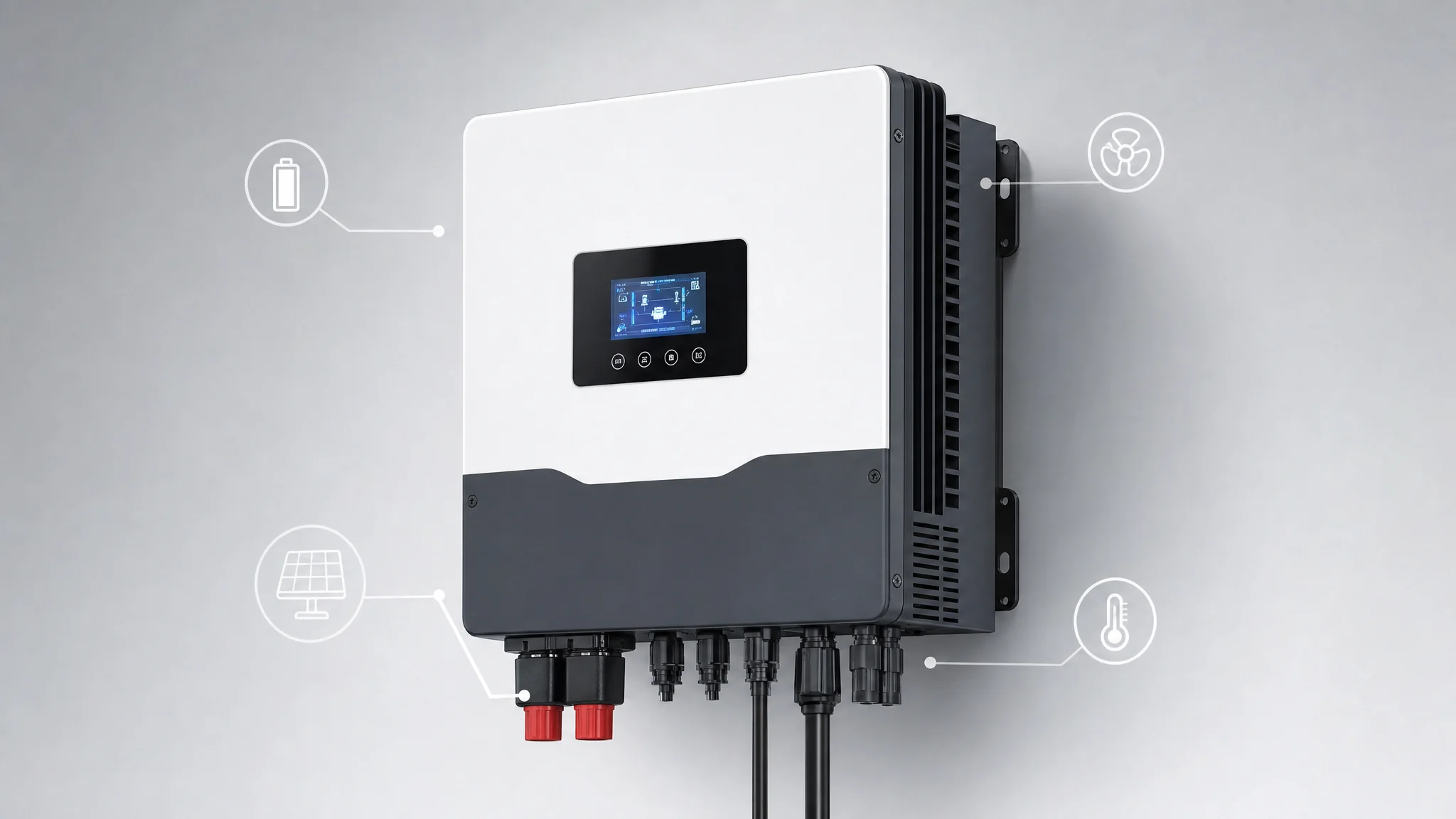

The hybrid inverter is the brain of a backup solar system. It decides when to charge the battery, when to export, when to switch off the grid, and how to protect your appliances during a blackout. Pick the wrong one and no amount of expensive battery capacity will save you.
This guide covers the nine specifications that genuinely affect performance — and the marketing numbers you can safely ignore.
First: What Makes an Inverter “Hybrid”?
A hybrid inverter can handle four energy directions in one box:
- Solar DC → AC (power your loads)
- Solar DC → battery (charge)
- Battery DC → AC (backup / peak shaving)
- Grid ↔ battery ↔ loads (import/export)
A plain string inverter only does #1. An off-grid inverter does #1–3 but not #4. Only a hybrid does all four — which is why it’s the core of any system that needs both bills-savings and blackout backup. See the off-grid vs hybrid vs grid-tied comparison for when each applies.
The 9 Features That Matter
1. Switchover speed (UPS transfer time)
The single most important spec for blackouts.
When the grid fails, the inverter must disconnect and start powering loads from the battery. That gap is the transfer time.
| Transfer time | Effect |
|---|---|
| > 100 ms | Computers and routers may reboot |
| 20–100 ms | Most equipment survives; sensitive gear may reset |
| < 20 ms | Seamless — nothing notices |
Look for sub-20 ms. Deye hybrids typically quote ~4–20 ms. For a home business running POS terminals or medical devices, this is non-negotiable.
2. True off-grid capability
Some “hybrid” inverters still need the grid to operate or black out their output entirely when the grid fails. Check explicitly that the unit supports off-grid / island mode with full load support. This is the feature that separates real backup inverters from grid-tie units with a battery bolted on.
3. MPPT count and voltage range
MPPTs (Maximum Power Point Trackers) let the inverter extract maximum power from partially shaded or differently-angled arrays.
- 1 MPPT — all panels must share the same orientation.
- 2 MPPT — ideal for two roof faces (east/west).
- 3+ MPPT — large or complex roofs.
Also check the MPPT voltage window. A wide range (e.g. 125–500 V) gives flexibility in string design and tolerates cloudy-day voltage drops.
4. Rated power and surge capacity
- Continuous rating = what it delivers all day.
- Surge rating = brief peak for motor startups (fridges, pumps).
Rule: size the inverter for your surge, not your average. A 5 kW inverter usually delivers ~10 kW for a few seconds. Need help? Our sizing guide shows the math.
5. Battery communication (CAN / RS485)
The inverter and battery must talk to each other. Without a communications protocol (CAN or RS485), the inverter guesses battery state by voltage — which is unreliable under daily deep cycling and shortens battery life.
Check: does the inverter officially support your battery brand’s protocol? GSL Energy, Deye, Pylontech and others publish compatibility lists. This is exactly the kind of compatibility trap covered in our LiFePO4 buyer’s guide.
6. Parallel capability
If you might expand, buy an inverter that can run in parallel with additional units for more power or 3-phase output. Parallel support is what lets a single-phase 8 kW grow into a 16 kW or 3-phase 24 kW system later.
7. Grid-export / net-metering support
If you plan to sell surplus (especially in Poland under net-billing), confirm the inverter supports grid export and meets your country’s grid code. A backup-only inverter that can’t export wastes your surplus. Context: subsidies guide.
8. Efficiency and idle consumption
- Conversion efficiency: 96–98% is top-tier; below 95% wastes energy.
- Idle/standby consumption: matters for off-grid systems running 24/7 — a few watts of parasitic draw adds up over a year.
9. Monitoring, firmware, and load management
- App monitoring: real-time and historical data, remote firmware updates.
- Load management: ability to split critical vs non-critical circuits (e.g. a dedicated backup output) so the inverter can shed non-essential loads when the battery runs low. Essential for long blackouts.
Brand Landscape (2026)
| Tier | Brands | Best for |
|---|---|---|
| Premium | Victron, SMA | Maximum reliability, off-grid purists |
| Value leaders | Deye, Growatt | Best balance for Ukraine/Poland |
| Mid-range | Sungrow, FoxESS, SolaX, Goodwe | Good features, solid value |
| Budget | SRNE, MPP Solar, EASUN | DIY, entry-level off-grid |
Deye dominates the off-grid/backup conversation for good reason: fast switchover, wide MPPT range, strong parallel support, and broad battery compatibility. Growatt is the value alternative. Compare both in our Deye vs Growatt vs GSL breakdown, and see the full field in the top 10 inverters list.
Specs You Can Ignore
- “Peak” marketing wattage with no continuous rating time.
- Maximum PV input far above your array size — irrelevant unless you’ll expand.
- Exotic features (AI optimisation, blockchain, etc.) that don’t change real-world performance.
- Wi-Fi vs. LAN vs. 4G dongles — nice to have, but connectivity shouldn’t drive the purchase.
Buying Checklist
Before you buy any hybrid inverter, confirm:
- [ ] Sub-20 ms transfer time
- [ ] True off-grid/island mode
- [ ] At least 2 MPPTs, wide voltage window
- [ ] Surge rating covers your motor loads
- [ ] CAN/RS485 protocol matches your battery
- [ ] Parallel-capable (if you may expand)
- [ ] Grid-export support (if you’ll sell surplus)
- [ ] ≥96% efficiency
- [ ] Backup output for load management
- [ ] Available firmware updates + meaningful warranty (5–10 yrs)
Sizing Your Inverter
| Your daily need | Inverter size |
|---|---|
| 2–4 kWh | 3–5 kW |
| 4–8 kWh | 5–8 kW |
| 8–14 kWh | 8–10 kW |
| 14 kWh+ or 3-phase | 10–15 kW (or parallel) |
Match this to a properly sized battery with the power backup sizing guide.
The Bottom Line
Forget the brochure wattage. The hybrid inverter that serves you best in Ukraine and Poland has sub-20 ms switchover, true off-grid mode, 2+ MPPTs, and verified battery communications.
Get those four right, confirm parallel expansion, and you’ll have a brain that keeps the lights on for years.
Read next: Top 10 solar inverters 2026 · How to size your backup system · LiFePO4 lifespan guide