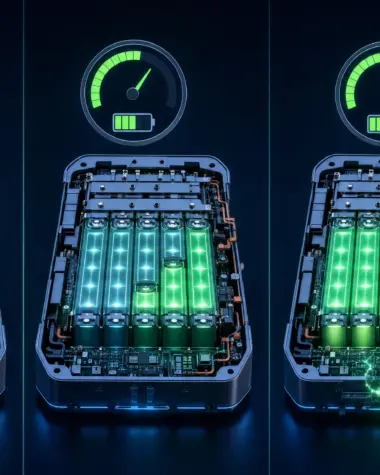

There are dozens of battery options on the market. But only a few are built for daily deep cycling — which is what 16-hour blackouts demand.
This guide walks you through every decision point, written for two audiences: business owners who need to understand their options, and installers who need spec’ing guidance.
Step 1: Chemistry — One Choice Only
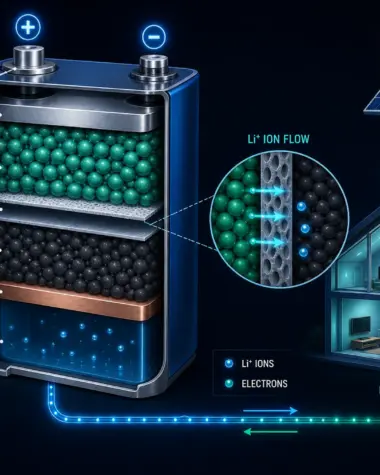
LiFePO4. That’s it.
| Chemistry | Daily Cycling | Safe? | Cost per Cycle | Verdict |
|---|---|---|---|---|
| LiFePO4 | 6000–10000 cycles | ✅ Very safe | ~€0.02/kWh | The only choice |
| NMC | 2000–4000 cycles | ⚠️ Fire risk | ~€0.05/kWh | Avoid for home |
| Lead-Acid | 300–600 cycles | ⚠️ Gasses | ~€0.20/kWh | Do not buy |
Real talk for business owners: You’ll see “cheap” lead-acid batteries at half the price. Don’t. They’ll need replacing in 12–18 months of daily cycling. LiFePO4 lasts 15+ years. The “cheap” option costs 5x more over 10 years.
Step 2: Voltage — 48V vs High Voltage
| Voltage | Flexibility | Expandability | Safety | Best For |
|---|---|---|---|---|
| 48V (Low Voltage) | ✅ High | ✅ Easy | ✅ Safer | Most systems |
| High Voltage (200–800V) | ⚠️ Less | ⚠️ Harder | ⚠️ More caution needed | Premium all-in-one systems |
Our recommendation: Choose 48V. It’s compatible with most inverters (Deye, Growatt, Victron), easy to expand, and safer to install and maintain.
Step 3: Capacity — The Real Sizing
This is where most people get it wrong.
For 4-Hour Blackouts (Western Europe)
- 5 kWh is usually enough for essentials
- This is what most guides recommend
For 16-Hour Blackouts (Ukraine)
- Essentials only (fridge, lights, internet): 8–10 kWh
- Full business (fridge, lights, pump, freezer): 15–20 kWh
- Full business + heating (heat pump): 20–30 kWh
- With 5kW solar panels: subtract ~40% (solar recharges during the day)
The golden rule: Buy the biggest battery you can afford. Most people’s first regret is not getting enough capacity. And if you buy a battery that supports parallel expansion, you can add more later.
Step 4: The BMS — What Installers Need to Check
The Battery Management System is more important than the brand.
A good BMS does:
- Cell balancing (keeps all cells at the same voltage)
- Overcharge protection (stops charging when full)
- Over-discharge protection (cuts off before damage)
- Temperature monitoring (shuts down if too hot or cold)
- Communication with inverter (CAN or RS485)
Communication is critical. Without CAN bus communication, the inverter can only estimate battery charge by voltage — which is inaccurate under load. With CAN, the inverter knows exactly how much energy is remaining and can optimize accordingly.
What to look for:
| BMS Features | Budget | Good | Excellent |
|---|---|---|---|
| CAN bus | ❌ Voltage-only | ✅ CAN | ✅ CAN + RS485 |
| Cell balancing | Passive only | Passive | Active |
| Temperature sensors | 1 sensor | 1 per module | 1 per cell |
| Low-temp charge cutoff | ❌ | ⚠️ Basic | ✅ Built-in heater |
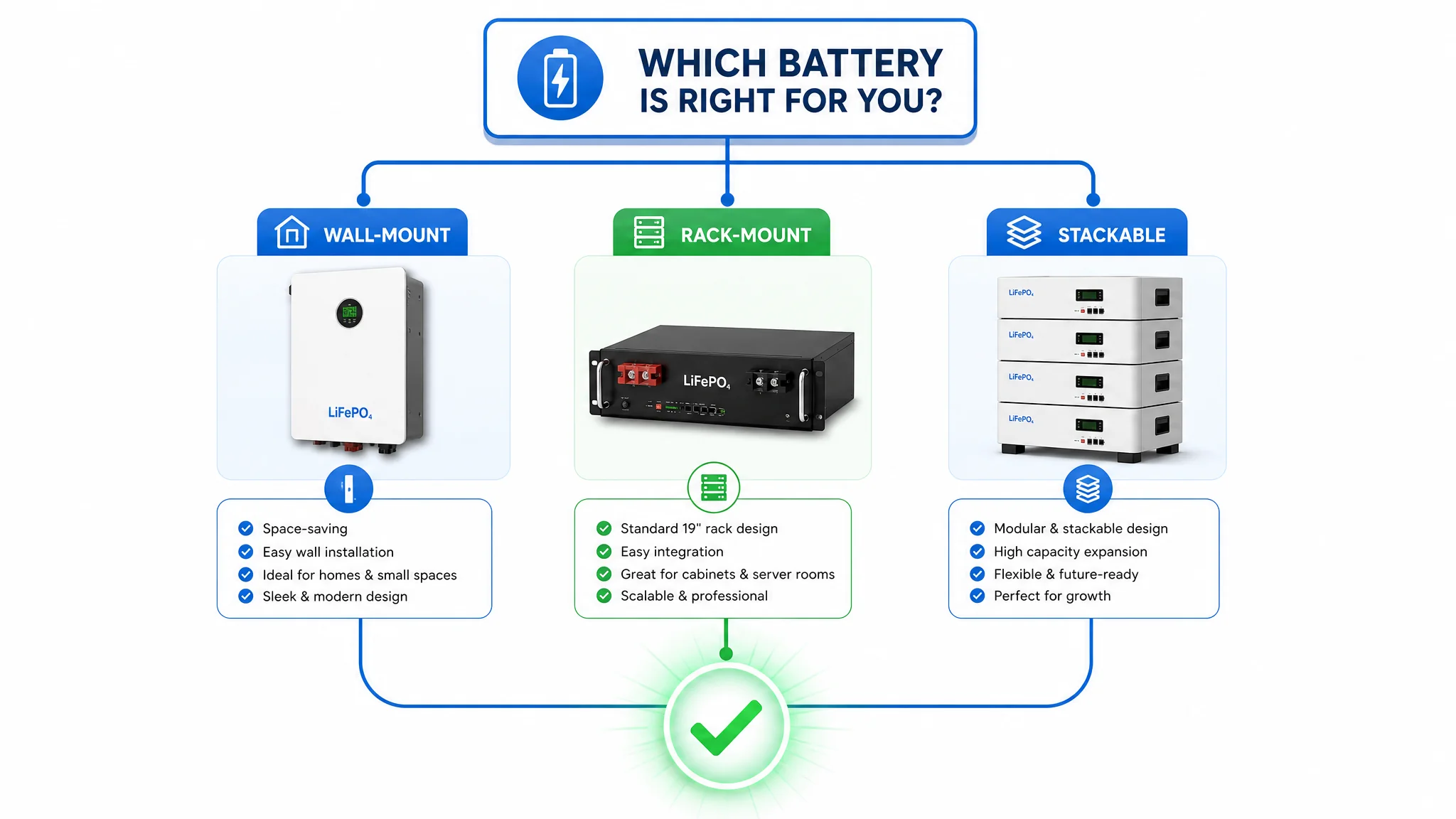
Step 5: Form Factor — Where Will It Live?
Wall-Mount
- Hangs on a wall like a picture frame
- Looks clean, saves floor space
- Best for: homes, small offices
- Example: GSL Energy wall-mount, Deye S series
Rack-Mount (Server Rack)
- Rectangular modules in a metal rack
- Professional look, easy to expand
- Best for: utility rooms, shops, commercial spaces
- Example: Deye RW-M series, GSL rack-mount
Stackable Floor Units
- Boxes that stack vertically
- Best for: basements, areas with floor space
- Example: Growatt APX, FoxESS
Recommendation: Wall-mount or rack-mount. Both look professional and are easy to service.
Step 6: Brand Selection
| Brand | Price/kWh | Cycle Life | Warranty | Best For |
|---|---|---|---|---|
| GSL Energy | €120–150 | 6000+ | 8 years | Best value — works with Deye, Growatt, Victron |
| Deye | €150–200 | 6000+ | 10 years | Best integration with Deye inverters |
| Growatt | €130–170 | 6000+ | 5–10 years | Best for Growatt system pairings |
| Pylontech | €170–220 | 6000+ | 10 years | Proven reliability, higher price |
| BYD | €180–250 | 6000+ | 10 years | Premium, often HV only |
| FoxESS | €120–160 | 6000+ | 5–10 years | Budget all-in-one |
Step 7: Compatibility — The Installer’s Cheat Sheet
| Inverter | Works With GSL? | Works With Deye Battery? | Notes |
|---|---|---|---|
| Deye | ✅ CAN (Pylontech protocol) | ✅ Native (best) | GSL works perfectly with CAN |
| Growatt | ✅ CAN | ⚠️ Not native | GSL is better pairing for Growatt |
| Victron | ⚠️ With proper BMS setup | ⚠️ Not native | GSL + Victron needs Venus/diode |
| FoxESS | ✅ CAN | ⚠️ | GSL is good pairing |
| Goodwe | ✅ Check compatibility | ⚠️ | GSL or Pylontech |
The safest bet for installers: GSL Energy battery + Deye inverter. It’s the most common combo in Ukraine, CAN communication works out of the box, and both are well-supported.
Step 8: Budget — What You Should Spend
| Battery Size | Budget (€) | Good (€) | Premium (€) |
|---|---|---|---|
| 5 kWh | €600–750 | €750–900 | €900–1,200 |
| 10 kWh | €1,200–1,500 | €1,500–2,000 | €2,000–2,500 |
| 15 kWh | €1,800–2,000 | €2,000–2,800 | €2,800–3,500 |
| 20 kWh | €2,400–2,800 | €2,800–3,800 | €3,800–4,500 |
The sweet spot for 2026: GSL Energy at €120–150/kWh. You get 6000-cycle LiFePO4 with good BMS at a price that makes the payback math work.
Bottom Line (for Business Owners)
- Buy LiFePO4 — nothing else survives daily cycling
- Buy 48V — most flexible, most compatible
- Buy at least 10 kWh — 15–20 kWh is better for business backup
- Buy from a known brand — GSL Energy, Deye, or Growatt
- Buy expandable — you’ll want more capacity within a year
Bottom Line (for Installers)
- Standardize on 1–2 battery brands — GSL Energy for value, Deye for premium. Stock one, learn it well.
- Always connect CAN — voltage-based estimation is unreliable for daily cycling
- Size the battery for 16 hours — not 4 hours. The Ukraine reality.
- Leave expansion room — clients always want more capacity later
- Don’t skimp on BMS quality — a cheap BMS kills cells, and then the client blames you
📌 Next: BESS Explained — Complete Systems for Homes & Businesses
📌 Read the LiFePO4 Buyer’s Guide for deeper chemistry and sizing detail.