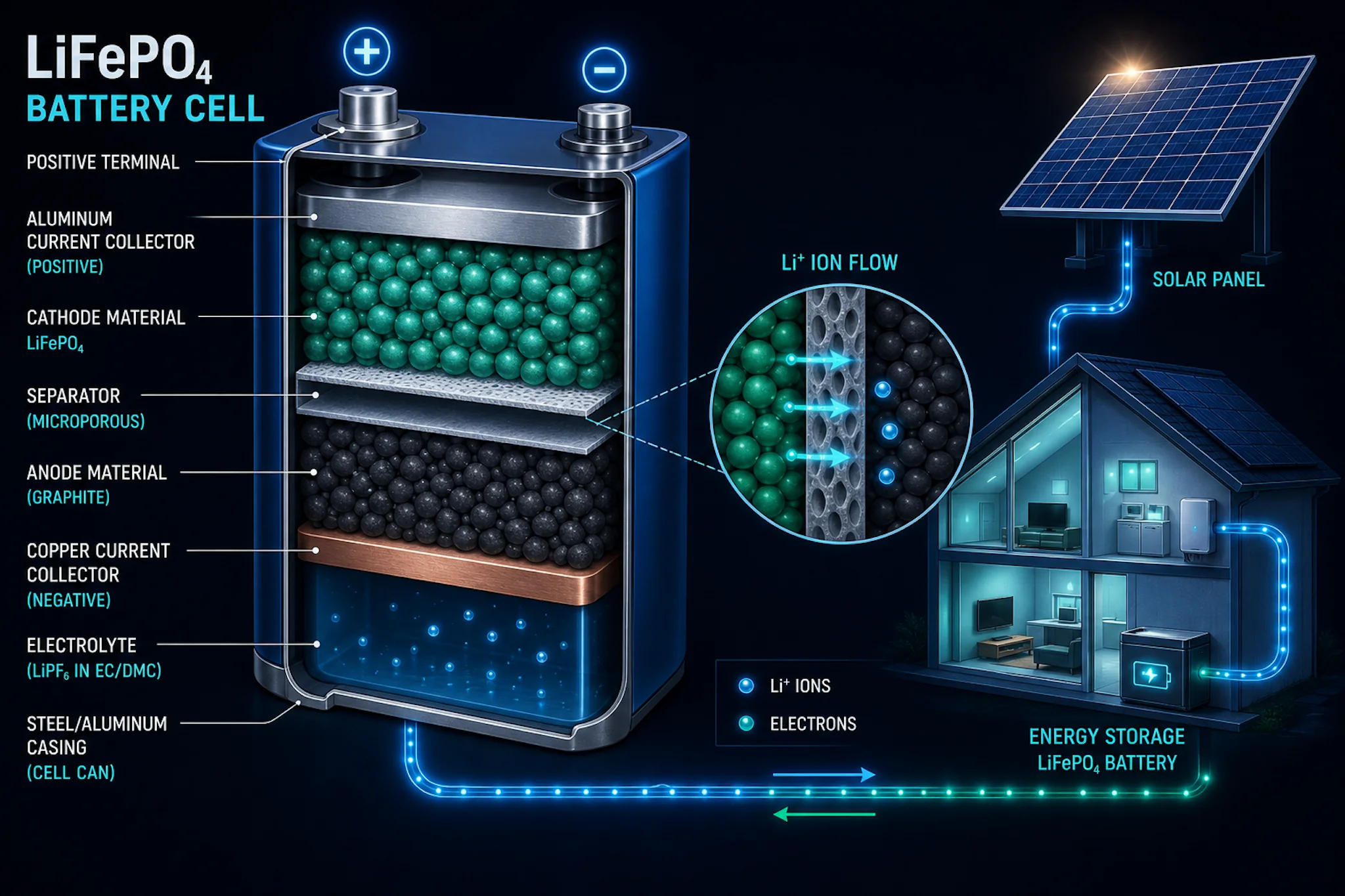

The battery is the most important part of your backup system. Not the inverter. Not the panels. The battery.
Because during a 16-hour blackout, your battery is the only thing keeping your fridge cold, your pump running, and your business open.
This guide covers everything a business owner or installer needs to know about choosing LiFePO4 batteries for daily, deep-cycle use — which is what Ukraine’s current reality demands.
The One Question Nobody Asks
Most battery reviews online ask: “How much can I save on my electricity bill?”
The real question for 2026 Ukraine: “Can this battery survive being charged and discharged to 90% depth of discharge, every single day, for years?”
Because that’s what daily 16-hour blackouts do to a battery. It’s not “backup” cycling. It’s primary cycling. And most battery chemistries can’t handle it.
Why Only LiFePO4 Makes Sense
| Chemistry | Daily Deep Cycle Life | Cost per Cycle | Safe? | Verdict |
|---|---|---|---|---|
| LiFePO4 (LFP) | 6000–10000 cycles (16+ years) | ~€0.02/kWh | ✅ Very safe | The only choice |
| NMC (lithium-ion) | 2000–4000 cycles | ~€0.05/kWh | ⚠️ Fire risk indoors | Avoid for home |
| Lead-Acid (AGM/Gel) | 300–500 cycles | ~€0.20/kWh | ⚠️ Gasses, heavy | Outdated |
| Lead-Carbon | 1000–1500 cycles | ~€0.12/kWh | ⚠️ Gasses, heavy | Niche |
Real talk: We’ve seen lead-acid batteries installed for backup in Ukraine in 2022. By 2024, most were dead. Every single one. LiFePO4 from 2022? Still running at 95%+ capacity.
Sizing for 16-Hour Blackouts (Not 4-Hour Ones)
Most guides size batteries for 4-hour “evening peak” backup. That’s California logic. It doesn’t apply here.
Step 1: Calculate Your Critical Loads
This is what a small business in Ukraine actually needs to run:
| Appliance | Power (W) | Hours/Day on Battery | Energy (kWh/day) |
|---|---|---|---|
| Refrigerator (commercial, compressor cycling) | 300W avg | 16h | 4.8 kWh |
| Freezer (upright) | 250W avg | 16h | 4.0 kWh |
| LED lighting (10 bulbs) | 100W | 16h | 1.6 kWh |
| Water pump (well or building) | 800W (runs 2h total) | 2h | 1.6 kWh |
| Router / WiFi | 20W | 16h | 0.3 kWh |
| Laptop / POS terminal | 100W | 8h | 0.8 kWh |
| Security cameras + DVR | 50W | 16h | 0.8 kWh |
| Total critical | ~14 kWh/day |
Step 2: Account for Inefficiency
Batteries aren’t perfectly efficient. Inverters aren’t perfectly efficient. Add 15% overhead.
Adjusted daily need: 14 kWh × 1.15 = ~16 kWh usable capacity
Step 3: Add “No Solar” Margin
If the client doesn’t have solar panels (or it’s a cloudy day), the battery is the ONLY source. Add 25% margin.
Recommended usable capacity: 20 kWh
Quick Reference (Usable Capacity Needed)
| Situation | Without Solar | With Solar (5kW+) |
|---|---|---|
| 4h blackout | 3–5 kWh | 2–3 kWh |
| 8h blackout | 8–10 kWh | 5–8 kWh |
| 12h blackout | 12–15 kWh | 8–12 kWh |
| 16h blackout | 18–22 kWh | 12–16 kWh |
| Full off-grid (24/7) | 25–35 kWh | 18–25 kWh |
Important for installers: LiFePO4 can be safely discharged to 90% DoD. A “20 kWh” battery (rated capacity) gives you ~18 kWh usable. But we recommend keeping a 10% reserve for battery health — so size the bank 10–15% larger than your calculated need.
Key Specs That Matter for Daily Cycling
Cycle Life — The #1 Spec
For daily deep cycling, you need 6000+ cycles at 80% DoD.
- Cheap LiFePO4: 3000–4000 cycles (lasts 8–10 years)
- Good LiFePO4: 6000–8000 cycles (lasts 16–22 years)
- Premium LiFePO4: 10000+ cycles (lasts 27+ years)
| At what cost per kWh? | Cycle Life | Fair Price/kWh |
|---|---|---|
| 3000–4000 | €100–130 | |
| 6000–8000 | €130–180 | |
| 10000+ | €180–250 |
BMS Quality
A cheap BMS kills batteries. Look for:
- CAN bus (for inverter communication) — not just voltage-based cutoff
- Cell balancing — passive is fine; active is better
- Temperature sensors — on every cell, not just one
- Over-discharge protection — critical for deep daily cycling
Low-Temperature Charging
If the battery is in an unheated garage or utility room: LiFePO4 shouldn’t be charged below 0°C (some can go to -20°C with built-in heating). If the battery will be in sub-zero temps, buy one with built-in heating pads (GSL and Deye offer these).
Top Battery Recommendations for Ukraine / Poland 2026
🥇 GSL Energy — Best Overall Value
- Price: €120–150/kWh
- Cycle life: 6000+ at 80% DoD
- BMS: Excellent CAN/RS485, compatible with Deye, Growatt, Victron
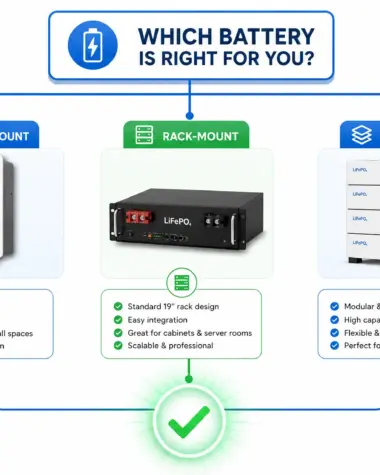
- Form factors: Wall-mount (sleek), rack-mount (utility room)
- Warranty: 8 years
- Heating option: ✅ (sub-zero charging)
- Best for: 90% of installs. Best value for money.
🥇 Deye — Best Integration
- Price: €150–200/kWh
- Cycle life: 6000+ at 80% DoD
- BMS: Seamless with Deye inverters (native CAN)
- Form factors: Wall-mount (S series), rack-mount (RW-M)
- Warranty: 10 years
- Heating option: ✅
- Best for: Premium installs, Deye inverter ecosystems
🥈 Growatt — Mid-Range Choice
- Price: €130–170/kWh
- Cycle life: 6000+ at 80% DoD
- BMS: Good with Growatt inverters
- Form factors: Stackable (APX, GBL series)
- Warranty: 5–10 years (model dependent)
- Heating option: ⚠️ Check model
- Best for: Growatt inverter pairings, Poland budget builds
Other Options
| Brand | Price/kWh | Notes |
|---|---|---|
| Pylontech | €170–220 | Proven, reliable, higher price |
| BYD | €180–250 | Premium, HV systems only usually |
| FoxESS | €120–160 | Budget, decent for Poland |
Common Mistakes Installers See
❌ 1. Buying too small
“I’ll start with 5kWh and see how it goes.” — Famous last words.
Within a week, the client adds a freezer. Then a pump. Suddenly 5kWh lasts 2 hours.
Solution: Size for the final need. Or at minimum, buy a battery that supports parallel expansion.
❌ 2. Mixing battery brands
One Deye battery + one GSL battery on the same inverter? Both have CAN. Both are 48V. Should work, right?
No. Different BMS protocols can conflict. Always use the same brand/model in parallel.
❌ 3. Ignoring the BMS-inverter pairing
Some batteries “work” without CAN communication — the inverter just uses voltage to estimate charge. That’s like driving a car without a speedometer.
Solution: Spend the 10 minutes to connect CAN. It’s worth it.
❌ 4. Lead-acid holdouts
“Lead-acid is cheaper.” No. It’s ~5x more expensive per cycle. And when the battery dies in 18 months, the client blames you.
❌ 5. No expansion plan
Client says they want 10kWh now. You install 10kWh. Six months later they want 20kWh. Your battery doesn’t support parallel.
Solution: Choose a brand that supports parallel addition (GSL, Deye, Growatt all do). Leave room in the rack/bay.
For Installers: Quick Compatibility Reference
| Battery Brand | Works With | CAN Protocol | Common Issues |
|---|---|---|---|
| GSL Energy | Deye, Growatt, Victron, Goodwe, FoxESS | Pylontech-compatible CAN | None reported |
| Deye | Deye only (native) | Proprietary CAN | Won’t talk to non-Deye inverters properly |
| Growatt | Growatt native + generic 48V | Pylontech-compatible CAN | Some third-party batteries need config |
| Pylontech | Most inverters | Standard CAN (widely adopted) | Higher price |
Bottom Line
- LiFePO4 only — anything else fails under daily deep cycling
- 20 kWh usable — minimum for full business backup during 16h blackouts
- GSL Energy — best value per kWh, works with all major inverters
- Invest in BMS — CAN communication is not optional for daily use
- Plan for expansion — clients always want more capacity later
For 9 out of 10 installs, the formula is: Deye/Growatt inverter + GSL Energy LiFePO4 battery. Size it right, wire CAN, and your client will be happy for 15+ years.
📌 Next article: ESS Explained — Building the Complete System
📌 Read before installing: Installation Guide for Installers