
Not everyone needs to rewire their home. Sometimes what you need is a box you can carry that keeps the fridge, router, and phone charger alive through a blackout — and recharges from a panel on the balcony.
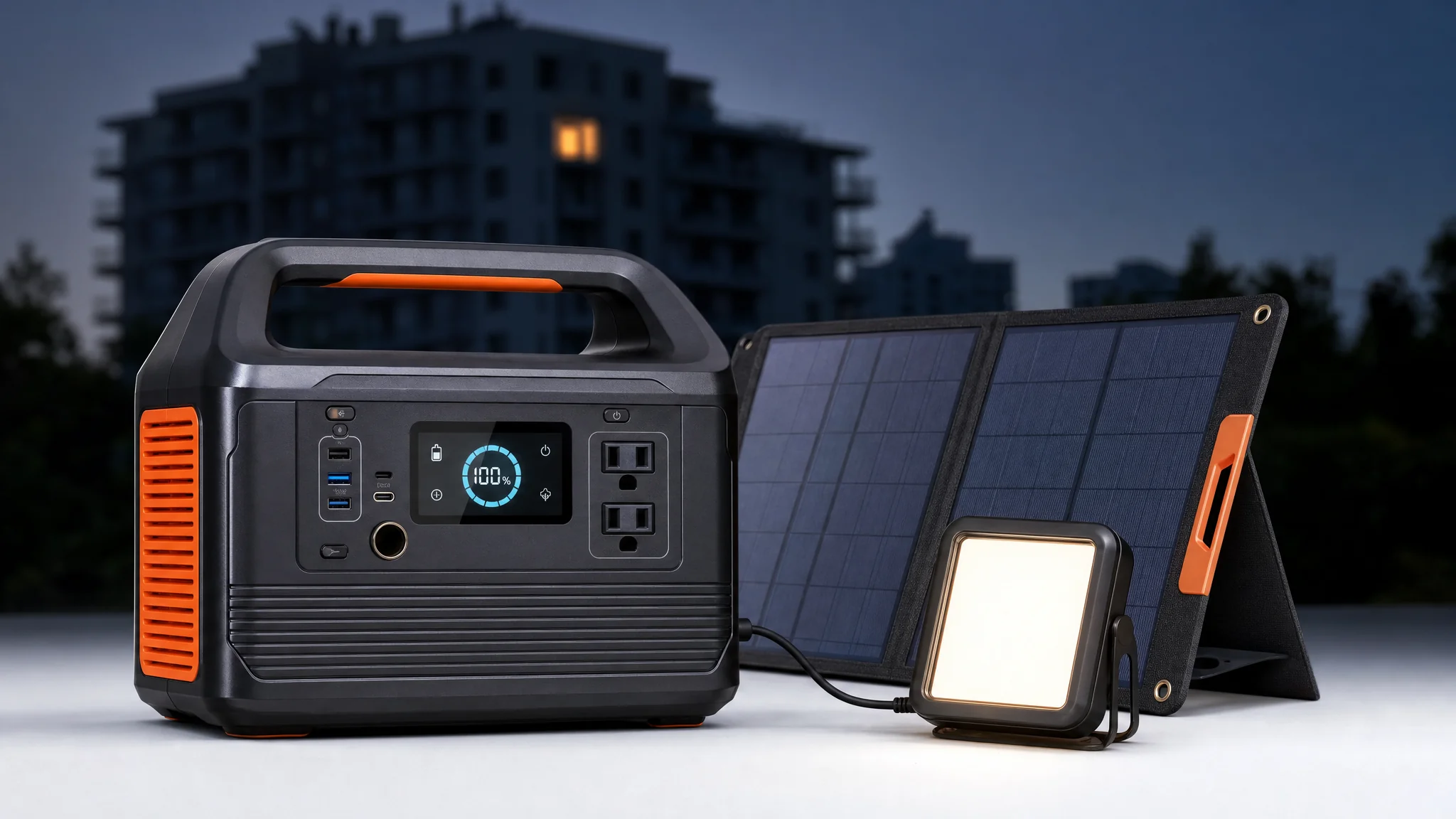
That’s the portable power station. This guide explains how they work, how to size them for a 16-hour outage, and — crucially — when a portable unit is enough and when you need a full home ESS.
Portable Power Station vs Solar Generator
These terms are often used interchangeably, but there’s a difference:
| Term | What it means |
|---|---|
| Portable power station | A battery + inverter + outlets in one box. Charges from wall/solar/car. |
| Solar generator | A portable power station bundled with solar panels. |
The “generator” name is marketing — there’s no fuel, no engine. It’s a battery that charges from the sun.
How They Differ From a Home ESS
| Portable station | Home ESS | |
|---|---|---|
| Capacity | 0.3–6 kWh | 5–30 kWh |
| Output | 300 W–3 kW | 3–15 kW |
| Install | None (plug & play) | Professional |
| Runs a house | Partially | Fully |
| Cost | €300–€4,000 | €4,000–€15,000 |
| Best for | Apartments, essentials | Whole home/business |
Think of a portable station as emergency essentials power; a home ESS as full property power. Our ESS beginner’s guide covers the latter.
What Can a Portable Station Actually Run?
It depends on two specs: capacity (Wh) and output (W).
| Appliance | Power (W) | Energy for 4 h |
|---|---|---|
| Phone charging | 10 | 40 Wh |
| LED lamp | 10 | 40 Wh |
| Wi-Fi router | 15 | 60 Wh |
| Laptop | 60 | 240 Wh |
| TV | 100 | 400 Wh |
| Fridge (cycling) | 120 avg | ~500 Wh |
| Electric kettle | 1,500 | 500 Wh (brews, high draw) |
| Space heater | 1,000+ | 4,000+ Wh ⚠️ |
Key insight: high-draw heating appliances drain any portable station fast. Portable power is for electronics and a fridge, not for heating.
Sizing for a Blackout
Estimate your essential load, then multiply by hours:
Example — apartment essentials for 16 h:
- Router (15 W) + 2 phones (20 W) + laptop (60 W) + LED lights (30 W) = 125 W
- For 16 h:
125 × 16 = 2,000 Wh
Add a fridge (500 Wh over the period) → ~2.5 kWh needed.
So you’d want a station of ~2.5–3 kWh (accounting for ~85% usable) — or a smaller one plus a solar panel to recharge during daylight.
For the full method, use our power backup sizing guide.
What To Look For
1. Capacity (Wh) and output (W)
- Capacity = how long. Output = how much at once.
- Check continuous and surge wattage.
- A 1,000 Wh station ≈ runs a 100 W load for ~10 hours.
2. Chemistry: LiFePO4 preferred
LiFePO4 (LFP) stations last 4,000+ cycles vs ~500–800 for older NMC units — much better long-term value. Same chemistry as a home battery; see the LiFePO4 maintenance guide.
3. Recharge speed & methods
- AC wall (fastest)
- Solar (the blackout-proof option)
- Car 12 V
- USB-C PD on newer models
For blackouts, solar input matters most — check the max solar input wattage and voltage range, and match it to a compatible panel.
4. Inverter type: pure sine wave
Must be pure sine wave for sensitive electronics and appliances. Modified sine wave can damage motors and electronics.
5. Pass-through & UPS mode
Some stations support UPS mode — they sit between the wall and your device and switch instantly during an outage. Great for routers and PCs.
6. Expandability
Can you add battery modules later? Modular stations grow with your needs.
7. Ports and output types
Count your needs: AC outlets, USB-A/C, 12 V car port, DC barrel. Make sure the types match your devices.
Brand Landscape (2026, tiers)
| Tier | Brands | Notes |
|---|---|---|
| Premium | EcoFlow, Bluetti | Fast charging, large capacity, high output |
| Mainstream | Jackery, Anker SOLIX | Reliable, wide range, good value |
| Budget | Various | Fine for phones/lighting, check chemistry |
Tip: prioritise LiFePO4 + solar input + pure sine wave over brand hype. A mid-tier LiFePO4 station usually beats a premium NMC one for repeated blackout use.
Portable Station vs Full ESS: Which Do You Need?
| Your situation | Best choice |
|---|---|
| Apartment, phones/laptop/router | Portable station (1–2 kWh) |
| Apartment + fridge, occasional outages | Larger station (2–3 kWh) + solar panel |
| House, need heat/pump/whole-home | Home ESS |
| Small business, 24/7 operations | Home ESS (10–20 kWh) |
| Both: essentials + full backup | ESS + a small portable for portability |
The hybrid approach many Ukrainians use: a permanent home ESS for the house, plus a portable station for the car, basement, or to lend to family.
Where Portables Win
- Zero installation — use it today.
- Portable — take it camping, to the cellar, to another property.
- Scalable — start small, add panels or a second unit.
- Silent, fumeless — safe indoors, unlike a generator.
- Great first step before committing to a full system.
Where They Fall Short
- Limited capacity — can’t run a whole house for long.
- Can’t run big heating loads for meaningful time.
- Cost per kWh is higher than a home ESS.
- Output limits — big appliances may exceed their rating.
Practical Setup for a Blackout Kit
- A 1–3 kWh LiFePO4 station (apartment) or larger for a house.
- A folding solar panel matched to the station’s input (e.g. 200–400 W).
- LED lamps and power banks as your low-draw base layer.
- Charge the station fully whenever the grid is up.
- Keep it in a mild location — not a freezing balcony.
The Bottom Line
Portable power stations and solar generators are the easiest entry into blackout preparedness — no installation, no fuel, no noise. For apartments and essentials, a 2–3 kWh LiFePO4 unit with a solar panel covers most outages.
But if you need to run a whole home or business — heating, pumps, refrigeration at scale — you need a proper home ESS. Many households use both.
Read next: What is an ESS? · How to size your backup · Solar vs diesel generator