
For decades the diesel generator was the default answer to a power cut. In 2026, in a region facing daily 16-hour blackouts, that default is being rewritten. The question isn’t just “which costs less to buy?” — it’s “which costs less to run?”
This guide puts solar + battery storage head-to-head with diesel generation across the numbers that actually matter: fuel, maintenance, noise, lifespan, and total cost of ownership.
The Short Answer
| Solar + Battery (ESS) | Diesel Generator | |
|---|---|---|
| Upfront cost | €5,000–€10,000 | €1,000–€5,000 |
| Fuel cost (16 h/day) | €0–€2 | €40–€80 |
| Maintenance | Minimal | Regular |
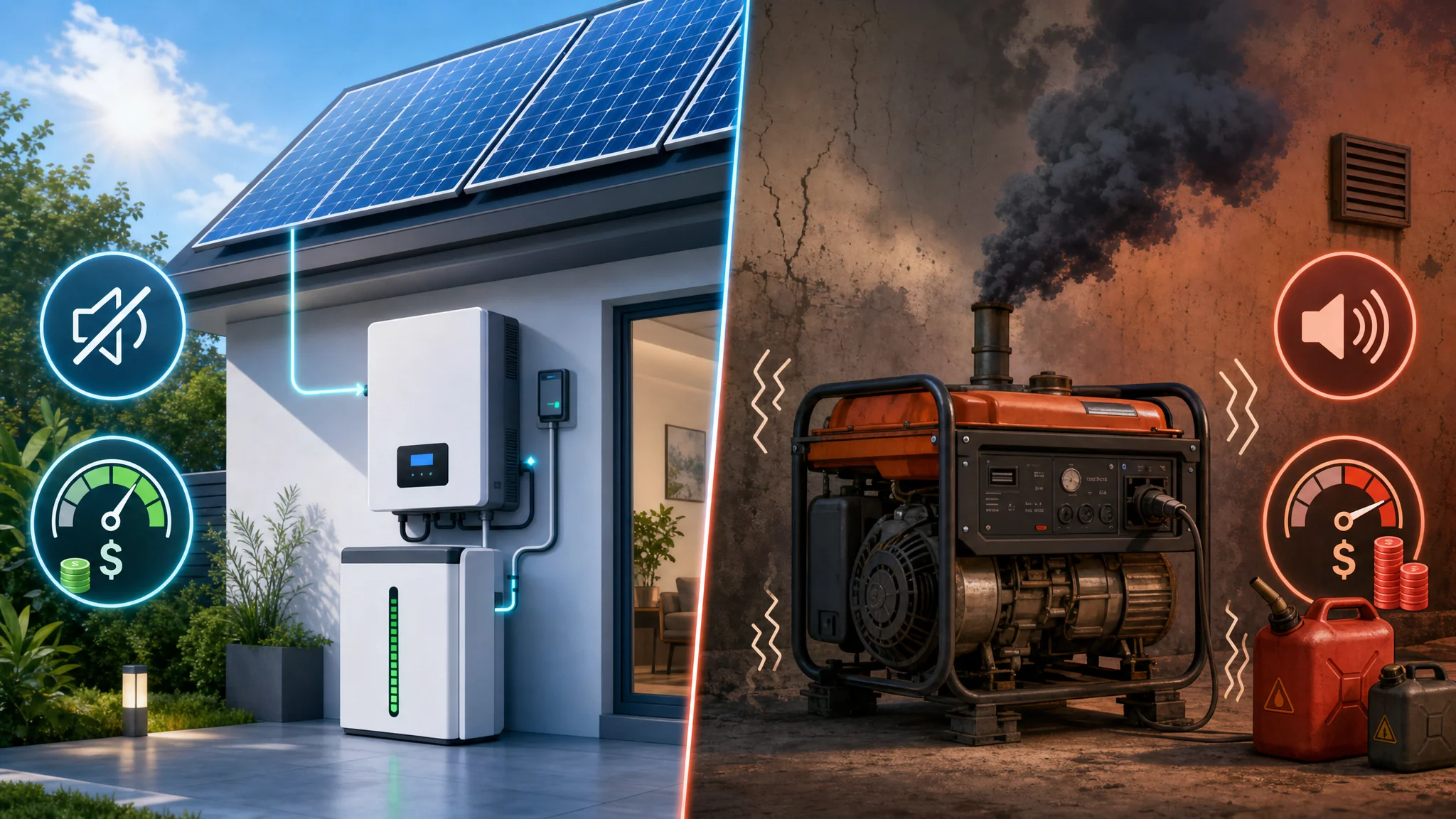
| Noise | Silent | 65–85 dB |
| Lifespan | 15–20 years | 5–10 years |
| Startup | Instant (<20 ms) | 10–30 seconds |
| 10-year cost | Lower | Far higher |
A generator wins on upfront price. A solar ESS wins decisively on everything after that — and in daily-blackout conditions, that gap becomes enormous within the first year.
Upfront Cost
| Item | ESS (hybrid + LiFePO4) | Diesel Generator |
|---|---|---|
| Equipment | €5,000–€8,000 | €1,000–€4,000 |
| Installation | €500–€1,500 | €300–€800 |
| Fuel tank / setup | — | €200–€600 |
| Total | €5,500–€9,500 | €1,500–€5,400 |
Generators are cheaper to buy. But that’s the only category they win — and it reverses fast once fuel enters the picture.
The Fuel Math (The Real Story)
Take a 5 kW diesel generator running a small business’s essential load for 16 hours a day:
- Consumption: roughly 1.5–2.5 L/hour under load
- At ~€1.50–€2.00/L → €35–€75 per day
- Over a 30-day month: €1,050–€2,250
- Over a 6-month blackout season: €6,000–€13,000
Compare an ESS:
- Charges from the grid when available, or from solar
- Running cost: near zero once installed
- Even fully grid-charged, electricity is a fraction of diesel
The verdict: a generator’s 6-month fuel bill alone can exceed the entire purchase price of a solar ESS.
Maintenance & Reliability
| Factor | ESS | Diesel Generator |
|---|---|---|
| Oil changes | None | Every 100–200 h |
| Filters/injectors | None | Regular |
| Fuel storage | N/A | Degrades, needs stabiliser |
| Cold-start issues | None | Common in winter |
| Parts availability | Good | Variable, war-affected |
| Remote monitoring | App-based | Rare |
Generators are mechanical devices with moving parts that wear out — especially under daily heavy use. An ESS has no engine, no oil, no exhaust.
War-time reality: diesel supply lines can be disrupted, prices spike, and queues form. An ESS that charges from the grid or sun is insulated from fuel-market chaos.
Noise, Emissions & Safety
- Generator: 65–85 dB (you will hear it), CO exhaust (must run outdoors, can be a theft target), heat.
- ESS: silent, zero emissions, safe indoors, no fuel to steal or store.
For apartments, urban areas, or anywhere near neighbours, this alone often decides the choice.
Lifespan & Total Cost of Ownership (10 Years)
| ESS (€6,000 + €2,000 battery replacement) | Generator (€3,000 + fuel + maintenance) | |
|---|---|---|
| Upfront | €6,000 | €3,000 |
| Fuel (seasonal use, 10 yr) | ~€2,000 (grid/solar) | €40,000+ |
| Maintenance | ~€500 | €4,000–€8,000 |
| Replacements | 1 battery bank | 1–2 engines |
| 10-year total | ~€8,500 | €50,000+ |
The generator’s lifetime cost can be 5–6× higher. That’s before counting downtime, noise complaints, or the health cost of exhaust fumes.
When a Generator Still Makes Sense
A generator isn’t obsolete — it has niche strengths:
- Very high short-term loads (welding, big motors) beyond ESS output.
- Multi-day, high-demand outages where battery runs dry and sun is scarce.
- Extreme budget constraints upfront.
- Mobile/construction sites with no fixed installation.
The smart hybrid: many businesses run both — an ESS for daily blackouts (silent, automatic, cheap) and a small generator as a rare multi-day backup. The ESS does 95% of the work; the generator sits idle.
Solar + ESS vs Generator: Feature Verdict
| Need | Winner |
|---|---|
| Lowest upfront cost | Generator |
| Lowest running cost | ESS |
| Best for daily outages | ESS |
| Silent operation | ESS |
| Indoor-safe | ESS |
| Highest peak output | Generator |
| Fuel independence | ESS |
| Longest lifespan | ESS |
| App monitoring | ESS |
The Hybrid Approach (Recommended)
For Ukraine in particular, the pragmatic setup is:
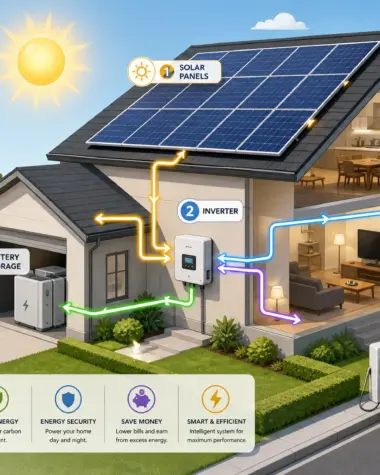
- Hybrid inverter + LiFePO4 battery sized for daily critical loads (see the sizing guide).
- Solar panels to recharge and cut grid dependence.
- A small generator as an emergency fallback for rare multi-day events.
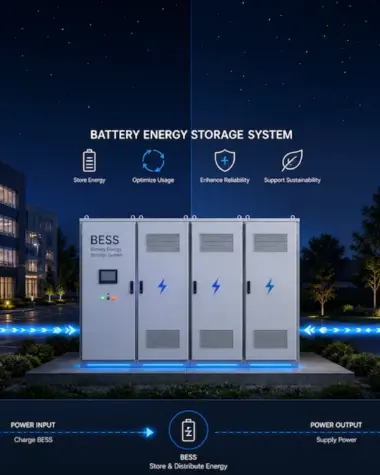
This gives you automatic, silent, cheap power every day, with the generator as insurance rather than a daily necessity. It also fits the architecture described in our BESS guide.
The Bottom Line
Buying a generator is cheaper on day one. Running one through a blackout season is far more expensive than most people expect — often more than a solar ESS costs to buy outright.
If outages are frequent and long, a solar + battery ESS pays for itself in avoided fuel alone, and keeps paying for 15+ years. The generator’s role shrinks to rare emergency backup.
Read next: ESS beginner’s guide · Portable power stations · How to size your backup system