
The most expensive mistake in backup power is guessing. Buy a battery that’s too small and it dies in four hours. Buy one that’s too big and you’ve spent thousands on capacity you’ll never touch.
This guide walks you through a real calculation — the same method installers use — so you can size an inverter and battery that runs your home or small business through a 16-hour blackout, with margin to spare.
By the end you’ll know exactly three numbers: your daily energy need (kWh), your peak load (kW), and your minimum battery capacity (kWh).
Why Sizing Is Harder Than It Looks
Most people estimate backup needs by listing appliances and adding up their wattage. That gives you the wrong answer for two reasons:
- Appliances don’t run continuously. A fridge cycles on and off. A pump runs in bursts. Your “total wattage” is not your real consumption.
- Watts and watt-hours are different things. A 60 W bulb running 16 hours uses 960 Wh — nearly 1 kWh. A 2000 W kettle running 3 minutes uses just 100 Wh.
You need to measure energy over time (Wh or kWh), not power at a moment.
If you’re comparing battery chemistries before we start, our LiFePO4 buyer’s guide explains why lithium is the right default for daily deep cycling.
Step 1 — Split Your Loads Into Two Groups
Write down everything you want to keep running. Then separate it:
Critical loads (must run during a blackout)
- Refrigerator / freezer
- Water pump or well pump
- Internet router + phone charging
- LED lighting (main rooms)
- Heating circulation pump (winter)
- Medical devices, security system, POS terminal
Non-critical loads (can be dropped)
- Washing machine, dishwasher
- Oven, electric stove, kettle
- Air conditioning
- EV charger
- Water heater / boiler element
Rule of thumb: your backup system is sized for critical loads. Everything else is a bonus you add capacity for later.
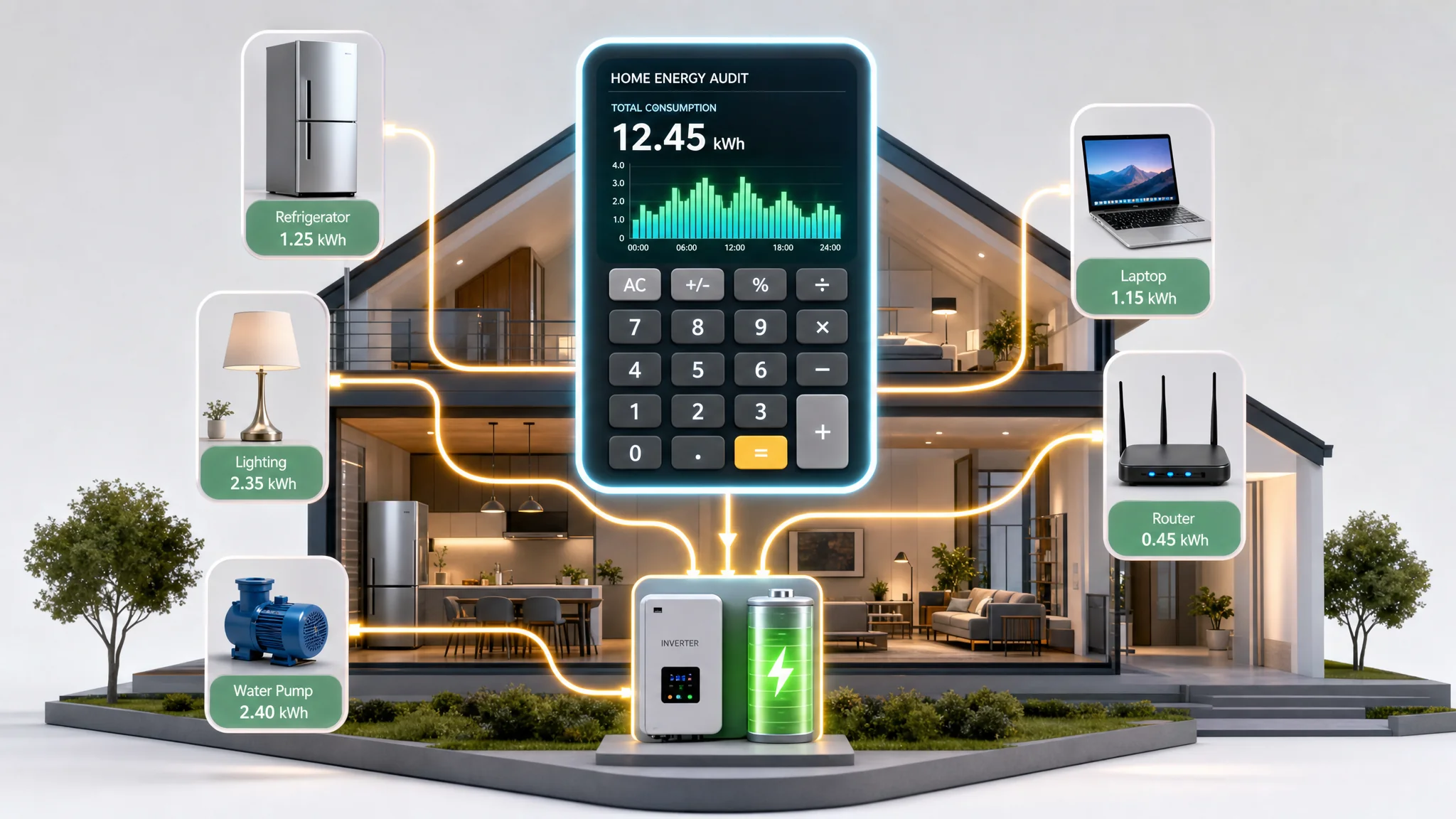
Step 2 — Calculate Daily Energy (kWh)
For each critical load, estimate its average running power and hours per day it actually runs.
Formula: Energy (Wh) = Average power (W) × Hours running
Here’s a worked example for a small home running 16 hours off-grid:
| Load | Avg power (W) | Hours/day | Energy (Wh/day) |
|---|---|---|---|
| Refrigerator | 120 | 8 | 960 |
| Freezer | 110 | 8 | 880 |
| Water pump | 800 | 1 | 800 |
| Router + phones | 30 | 16 | 480 |
| LED lighting (12 bulbs) | 120 | 6 | 720 |
| Circulator pump (winter) | 90 | 16 | 1,440 |
| TV + laptop | 150 | 4 | 600 |
| Total | 5,880 Wh ≈ 5.9 kWh |
That’s your baseline daily energy need: ~5.9 kWh.
Add a 15% buffer for inverter conversion losses (hybrid inverters run at ~90–95% efficiency): 5.9 × 1.15 ≈ 6.8 kWh.
Round up: 7 kWh/day.
Step 3 — Size the Battery (kWh)
LiFePO4 batteries should not be drained to 0%. Plan for 80–90% usable depth of discharge (DoD) to protect cycle life.
Formula: Required battery (kWh) = Daily need ÷ Usable DoD
7 kWh ÷ 0.9 ≈ 7.8 kWh
So you need roughly an 8 kWh usable battery.
⚠️ War-zone reality check: Ukrainian grids often stay down longer than one day. If you want two days of autonomy without sun, double it: ~16 kWh. Most businesses buy 10–20 kWh for this reason. See how we sized systems in the ESS beginner’s guide.
When you’re ready to pick modules, how to choose the right battery covers voltage, form factor, and CAN compatibility.
Step 4 — Size the Inverter (kW)
The battery stores energy; the inverter delivers power. Two numbers matter:
Continuous power
Your average simultaneous load. From the table, the sum of everything running at once is rarely above ~1.5 kW, but plan for the realistic worst case.
Surge power
Motors (fridges, pumps, compressors) draw 3–7× their rated power for a fraction of a second at startup.
| Appliance | Running | Startup surge |
|---|---|---|
| Fridge | 120 W | ~600 W |
| Freezer | 110 W | ~550 W |
| Water pump | 800 W | ~2,400 W |
If the pump and both compressors start together: 800 + 600 + 550 ≈ 2 kW surge on top of base load. A 5 kW hybrid inverter handles this comfortably with headroom.
Practical guidance:
| Daily need | Recommended inverter |
|---|---|
| Up to 4 kWh | 3–5 kW |
| 4–8 kWh | 5–8 kW |
| 8–14 kWh | 8–10 kW |
| 14 kWh+ / 3-phase | 10–15 kW (or parallel units) |
For brand choices, compare the top 10 solar inverters or read our Deye vs Growatt vs GSL breakdown.
Step 5 — Decide How Solar Fits In
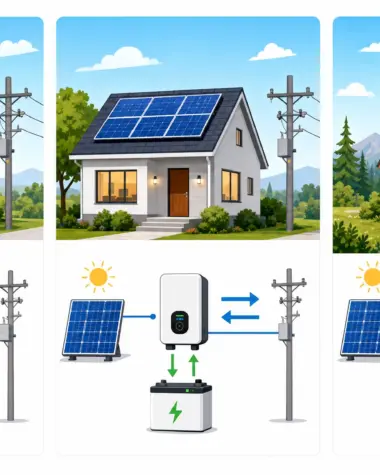
A battery alone has a hard limit. Add solar panels and your runtime becomes effectively unlimited during daylight.
Quick estimate: in Ukraine/Poland a 1 kW array produces roughly 2.5–3.5 kWh/day on a good day (lower in winter). To fully recharge your 8 kWh battery in a day, you’d want about 3 kW of panels — more in winter, less in summer.
Solar is optional but transformative. Many Ukrainian businesses install the inverter + battery first and add panels when budget allows — a smart staged approach our installation guide covers in detail.
Step 6 — Add It All Up
For our example home:
| Component | Specification |
|---|---|
| Daily energy need | 7 kWh (with losses) |
| Battery | 8 kWh usable (single day) / 16 kWh (two days) |
| Inverter | 5 kW hybrid, <20 ms switchover |
| Solar (optional) | 3 kW |
Total for one-day autonomy with solar: roughly €6,000–€9,000 depending on brand and installer.
Common Sizing Mistakes
- Counting nameplate watts as continuous load. Compressors and pumps cycle.
- Ignoring startup surge. Undersized inverters trip on motor start.
- Forgetting inverter losses. Always add 10–15%.
- Designing for 100% DoD. It works on paper and destroys your battery in two years.
- No expansion headroom. Leave space in the rack and spare MPPT capacity from day one.
- Skipping winter numbers. Days are short and cloudy — size solar for December, not July.
Quick Reference: Sizing by Property Type
| Property | Daily need | Battery | Inverter |
|---|---|---|---|
| Apartment (essentials) | 2–3 kWh | 3–5 kWh | 3 kW |
| Small home | 5–8 kWh | 8–10 kWh | 5 kW |
| Large home | 10–14 kWh | 15–20 kWh | 8–10 kW |
| Small shop / café | 8–16 kWh | 15–20 kWh | 8–10 kW |
| Workshop / clinic | 12–20 kWh | 20–30 kWh | 10–15 kW |
The Bottom Line
Calculating backup needs comes down to four steps: list critical loads → compute daily kWh → size battery for 80–90% DoD → size inverter for surge.
Do that math once and you’ll buy the right system the first time — no overspending, no running out of power at hour nine.
Next steps:
- Work out your own kWh with the table above.
- Compare inverter brands for your power range.
- Choose between system architectures before you buy.
Get the sizing right once, and your system will carry you through every blackout season that follows.